
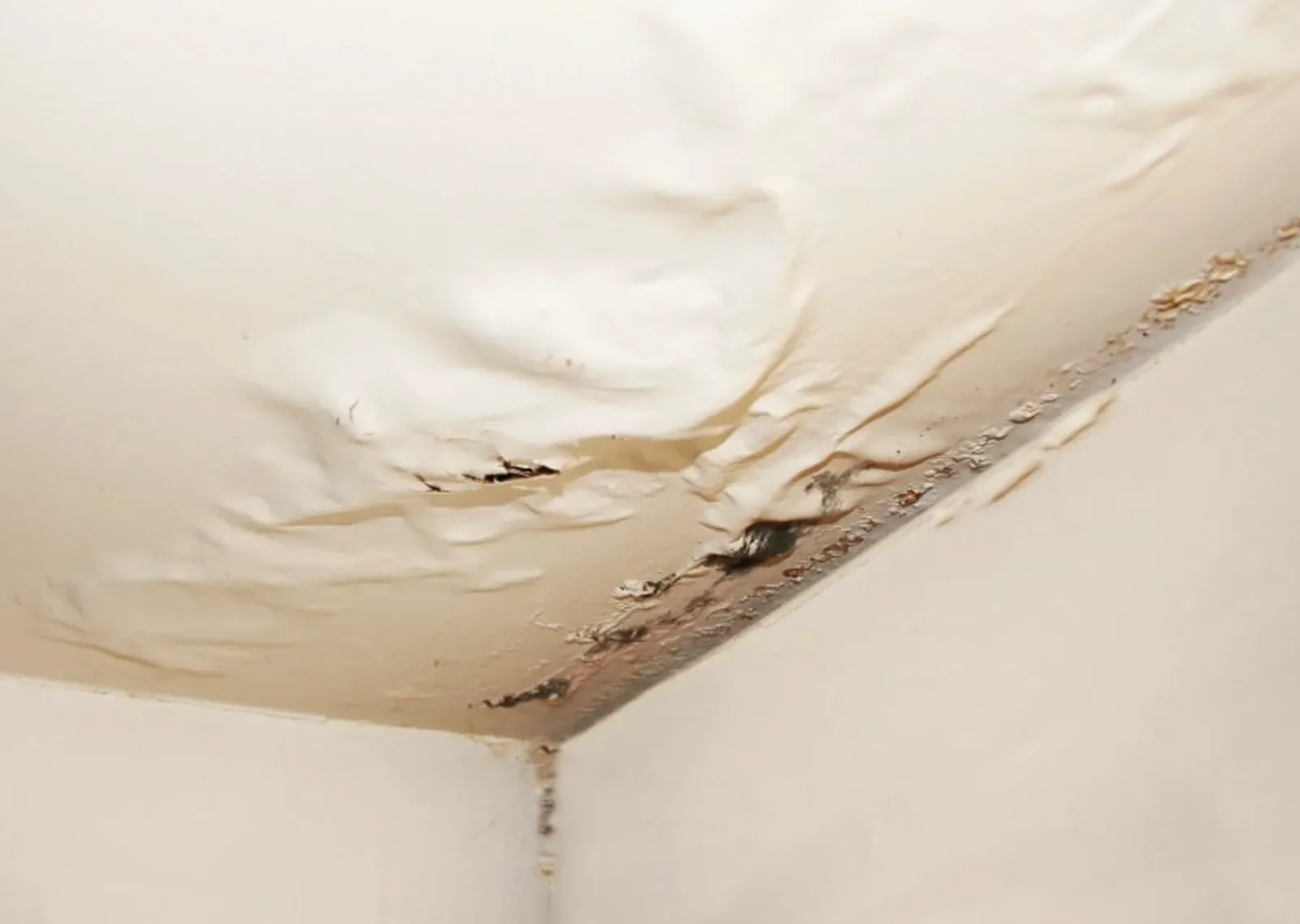
Signs you need this
- • A spreading brown or yellow ring on a ceiling, sometimes with a bulge in the center where the board is holding a pocket of water.
- • A wall that feels soft, cool, or spongy to the touch, or paint and joint tape that has blistered and lifted along a seam.
- • A ceiling that has started to sag, crack, or drip after a storm, an ice dam, an upstairs bathroom leak, or a burst supply line.
Lynn Drywall & Plaster removes drywall and ceiling material that water has soaked, dries and verifies the framing behind it, and rebuilds the wall or ceiling back to a clean, paint-ready finish. This is restoration work, not just a cosmetic patch: the point is to take out exactly the compromised board, confirm the cavity is dry, and hang new material that will not telegraph a stain or grow mold later. On claim jobs, the crew works to the adjuster’s scope and documents the moisture readings so the paperwork holds up.
This service is for Lynn homeowners in the city’s older housing stock who have just had a burst pipe, a failed water heater, or an ice-dam leak come through a plaster-and-lath or drywall ceiling. It is also for landlords and property managers on the low-lying Lynnway corridor and the tidal edges near the waterfront, where storm-driven and groundwater intrusion recur and a wet unit has to be turned around before the next tenant, and for owners of the grand pre-1939 coastal Victorians in the Diamond District near Lynn and Nahant Beach, where century-old plumbing and long roof runs feed slow ceiling leaks. Anyone working an active insurance claim gets a contractor that documents moisture readings and repairs to the adjuster’s scope.
The meter, not the eye, decides what comes out
A water stain tells you where water was, not where it still is. A brown ring can sit over board that has already dried, or over framing that is still soaked two bays past the visible edge. That is why the work starts with a moisture meter rather than a guess: Lynn Drywall & Plaster maps the wet boundary on the board and the framing behind it, so the crew removes exactly the compromised material and no more, and knows the true extent instead of cutting to the edge of the stain and hoping. Cutting back too little leaves wet material in the wall; cutting back too much turns a patch into an unnecessary rebuild.
Why closing a wet cavity is the mistake that repeats
The single failure that turns one repair into two is closing new board over framing that is still wet. Sealed inside a warm cavity, that moisture has nowhere to go and becomes the mold problem the homeowner calls about a few months later. The crew dries the framing and cavity and re-checks it with the meter until the readings fall below the safe threshold, around sixteen percent, before any new board goes up. New material is moisture-resistant board, taped and coated to match the surrounding Level 4 or 5 finish and any texture, so the repair disappears rather than reading as a patch.
Documentation that holds up on a claim
A lot of this work runs through insurance, and a claim is only as strong as its paper. Lynn Drywall & Plaster repairs to the adjuster’s scope and documents the moisture readings along the way: taken at diagnosis, verified again before the cavity is closed, and handed over at walkthrough for the file. That thread is what makes the repair defensible if the claim is questioned, and it is also what confirms, independent of the paperwork, that the unit is genuinely dry before anyone lives in it or it is re-rented.
Why the coastal housing makes this a recurring call
Lynn’s building stock keeps this work steady. The grand pre-1939 Victorians of the Diamond District near Lynn and Nahant Beach carry century-old plumbing and long roof runs that feed slow ceiling leaks, and New England ice dams push meltwater back under the shingles into upstairs ceilings every hard winter. Along the low-lying Lynnway corridor and the tidal edges near the waterfront, storm-driven and groundwater intrusion keeps landlords turning wet units around between tenants. Where the intrusion recurs, the crew will say plainly when the drywall repair is only half the answer and the water source itself needs to be addressed, rather than quietly rebuilding the same wall a second time.
Materials & standards
Products & materials we use
- USG Sheetrock
- National Gypsum Gold Bond
- CertainTeed
- purple/mold-resistant board
- Georgia-Pacific ToughRock
Standards & codes we work to
- Massachusetts State Building Code (780 CMR)
- ASTM C1396
- GA-214 finish levels (Level 4/5)
- EPA RRP (pre-1978 lead-safe)
What the terms mean
- moisture metering
- cut-and-replace
- cavity drying
- joint compound
- mud and tape
- corner bead
- stain-block sealer
- moisture-resistant board
- Level 4/5 finish
- knockdown texture
Options & variants
| Option | When it applies | Cost |
|---|---|---|
| Stain-only ceiling repair | A brief leak that has been fixed and dried, where the board tests dry but is discolored | Lowest; a stain-block seal, skim, and paint prep with little or no tear-out |
| Cut-and-replace section | A defined wet area on a wall or ceiling where the board has lost its bond | Moderate; tear-out, cavity drying, new board, tape and finish |
| Full ceiling or wall replacement | Widespread saturation, sagging, or a large flooded area | Higher; more board, more finish area, sometimes texture matching |
| Insurance-scope rebuild | A documented claim spanning several rooms or a whole unit | Scoped per adjuster line items; documented moisture verification |
What affects cost
- • How far the water traveled: a stain in one ceiling bay costs far less than saturation that ran down inside a wall cavity to the floor below.
- • Whether the framing and insulation are still wet and need drying time before new board can go up, since closing a wet cavity is what causes a repeat failure.
- • Access and height: a two-story stairwell ceiling or a finished basement below the Lynnway water table is more involved than a first-floor hallway.
- • The finish and texture that has to be matched, from a flat Level 4 wall to a knockdown or older skim-coat ceiling.
- • The age of the home: pre-1978 Lynn housing means lead-safe (EPA RRP) practice when the disturbed paint is old, which adds containment.
What to expect
- 1
Find the source and meter
Lynn Drywall & Plaster comes out, finds where the water is coming from or confirms the source is already fixed, and moisture-meters the board and framing so the wet boundary is known, not guessed.
- 2
Contain and protect
The work area is contained with plastic and the floors are protected before any cutting starts.
- 3
Cut back to sound board
The crew cuts back to sound, dry board, removing exactly the compromised section, no more.
- 4
Dry and verify the cavity
The framing and cavity are dried and re-checked with a meter, and new board goes up only once the readings are below the safe threshold, around 16%.
- 5
Hang and finish
New moisture-resistant board is hung, taped, and coated to match the surrounding Level 4 or 5 finish and any texture.
- 6
Clean up and document
The area is cleaned, walked through with the owner, and on claim jobs the moisture documentation is handed over for the file.
When this isn’t the right call
- If the wet board already shows heavy black or green growth and a musty smell, the job is mold-scope work, not a straight water repair, and mold drywall replacement is the better fit.
- If the damage is confined to a sagging or cracked ceiling with no active moisture, the leak having long since dried, ceiling repair is the better fit.
- If the wet surface is original lath-and-plaster in a historic home and the owner wants the plaster preserved rather than replaced, plaster repair and conversion is the better fit.
Frequently asked questions
My ceiling has a brown ring but it feels dry, do you still have to cut it open? +
Not always. Lynn Drywall & Plaster meters the board first; if it reads dry and the leak is fixed, the stain can be sealed with a stain-blocker and refinished. If it reads wet, it has to come out so the cavity does not grow mold.
How fast can you get here after a burst pipe? +
Water damage is treated as emergency work. Getting the wet material opened up and drying started quickly is what keeps a patch from turning into a full tear-out.
Will you work directly with my insurance company? +
Yes. Lynn Drywall & Plaster repairs to the adjuster's scope and documents moisture readings so the claim paperwork is supported.
Do you dry the wall, or do I need a separate company? +
For a contained leak, the crew dries and verifies the cavity as part of the repair. A large flood may need a dedicated water-extraction firm first, and Lynn Drywall & Plaster picks up the rebuild once the structure is dry.
Why not just paint over the stain? +
Paint over wet or unsealed water damage bleeds back through and hides moisture that keeps working in the cavity. The board has to test dry and the stain has to be properly sealed first.
My house is near the waterfront and this keeps happening, can you fix the recurring damage? +
Lynn Drywall & Plaster can repair the drywall and recommend moisture-resistant board in the assembly, but recurring intrusion on the low-lying Lynnway edge usually needs the water source addressed too, and the crew will tell you plainly when that is the real fix.