
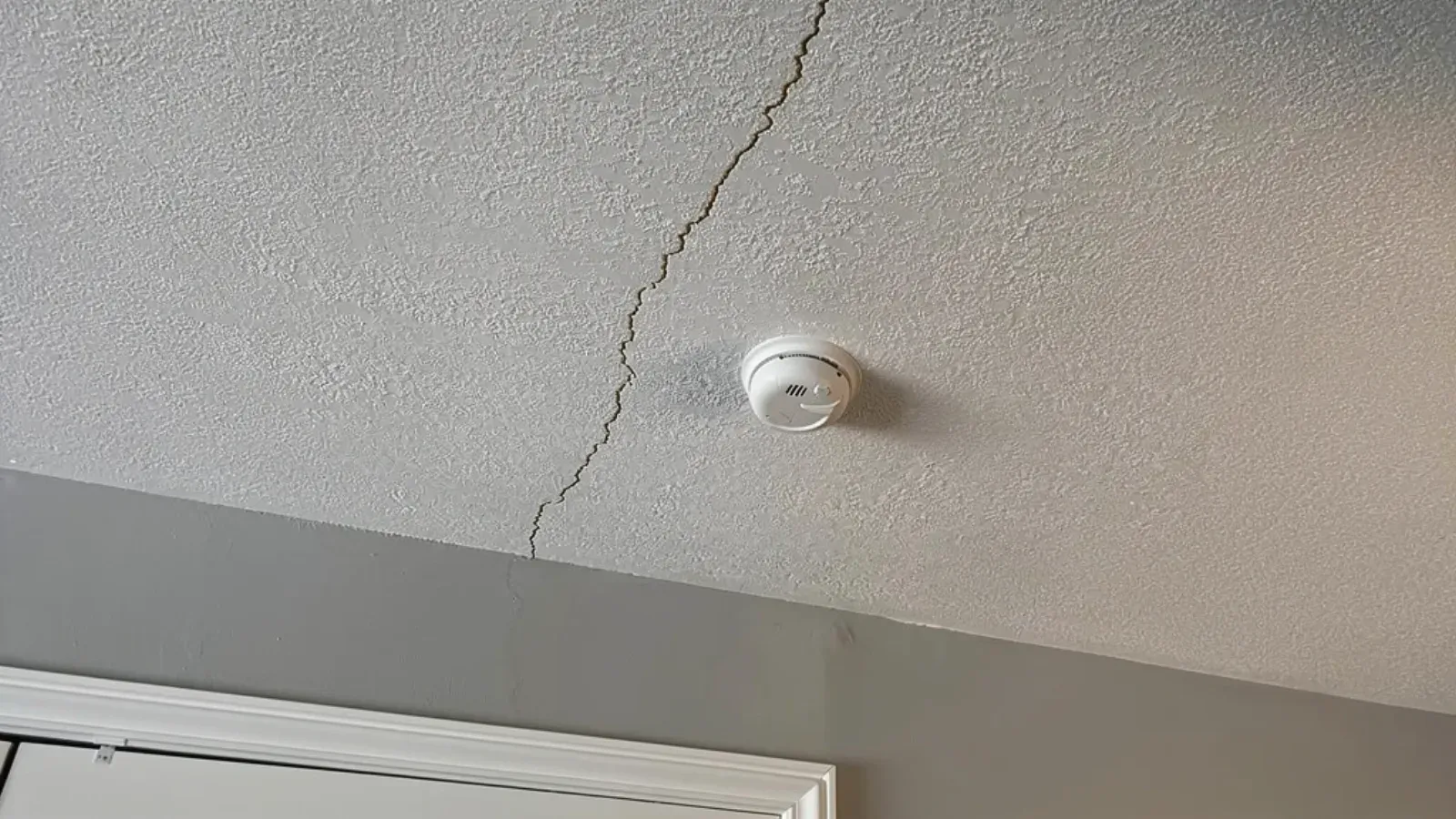
Signs you need this
- • A brown or yellow-brown ring spreading across a plaster or drywall ceiling, usually under a bathroom, a roof valley, or an old flat-roofed addition.
- • A soft spot or visible sag between joists where the ceiling has started to pull away from the lath or drywall screws.
- • Cracking that runs in a straight line along a seam, or a spiderweb pattern radiating from a light fixture box.
- • A stain that grows visibly wider after a storm or a thaw, or a ceiling that feels spongy when pressed.
- • A piece of plaster or drywall tape actually drops, or a chunk of the ceiling comes down overnight.
Lynn Drywall & Plaster diagnoses and repairs damaged ceilings, from a single water-stained patch to a full section that has separated from the framing. The work always starts with finding the moisture source, not just the visible damage, because covering a wet ceiling without addressing the leak is how the same stain comes back within months. Depending on the ceiling’s construction, the crew either patches and skim-matches existing lath-and-plaster or cuts back drywall to sound board and rebuilds the section to match the surrounding finish level.
This service is for owners of the Diamond District’s pre-1939 coastal Victorians, where original lath-and-plaster ceilings sit under aging built-up or low-slope roof sections exposed to nor’easter wind-driven rain off Nahant Beach. It’s also for triple-decker and two-family owners in the Highlands and Pine Hill whose top-floor ceilings take the brunt of attic condensation and ice-dam backup every winter, for landlords and property managers who inherited a stained ceiling from a tenant’s slow leak and need it assessed and repaired before it becomes a habitability complaint, and for homeowners near the Lynnway’s low-lying, flood-prone edge where storm surge and heavy rain push water into older roof-to-wall connections.
Reading a ceiling before you open it
A ceiling rarely fails at the exact spot where the water entered. Water travels along the top of the drywall or the back of the lath before it finds the lowest point to show through, which is why a stain over a bathroom might trace back to a roof penetration ten feet away. Before Lynn Drywall & Plaster cuts anything, the crew moisture-meters a grid around the visible stain to map how far the water actually traveled, because opening only the stained area often leaves wet material sealed behind the patch, and that’s how a “repaired” ceiling stains again within a season.
Lath-and-plaster versus drywall ceilings
Lynn’s housing stock splits sharply on this point. The shoe-era triple-deckers, two-families, and worker cottages that make up most of the Highlands, Wyoma, and Pine Hill were built almost entirely with lath-and-plaster ceilings, while postwar construction toward Saugus and Peabody uses drywall. The two systems fail differently and repair differently. Plaster keys into wood or metal lath in three coats, and a proper patch has to key into that same lath rather than just skim over the old plaster edge, or the patch will crack loose along its perimeter within a year or two. Drywall ceilings fail more often at the taped seams and screw pops, and a repair there is a cut-to-the-joist rebuild rather than a keyed patch.
Ice dams and the Diamond District roofline
The Diamond District’s coastal Victorians, close to Lynn and Nahant Beach, carry complex rooflines with dormers, bays, and built-up flat sections that trap snowmelt and back it up under the shingles during a New England freeze-thaw cycle. That backed-up water finds its way to the ceiling below the affected roof section, often at a wall-ceiling junction rather than the center of a room, which is a telltale sign of ice-dam origin rather than a plumbing leak. Homeowners get this pattern flagged plainly, because a ceiling repair alone won’t stop a recurring ice dam; the roofline needs attention too.
Why drying time isn’t optional
Gypsum board loses its structural bond when it stays wet, and the paper facing that holds the compound together starts to break down within days. Cutting out compromised material and confirming the remaining framing and board are dry, generally under 16% moisture content, before closing the cavity back up is standard practice here, not an upsell. Skipping that step and skinning a fresh coat of compound over a still-damp cavity is the single most common shortcut that leads to a callback for mold or a repeat stain.
Matching the finish
A ceiling repair that’s structurally sound but visually obvious under a lamp is still an unfinished job. Lynn Drywall & Plaster matches the surrounding ceiling’s texture, whether it’s a smooth painted plaster ceiling common in the Diamond District’s older homes or a knockdown texture in a newer build, and finishes the joint to the room’s existing finish level so the seam disappears rather than reading as a patch from across the room.
Materials & standards
Products & materials we use
- USG Sheetrock
- National Gypsum Gold Bond
- FibaTape
Standards & codes we work to
- Massachusetts State Building Code (780 CMR)
- GA-214 finish levels
What the terms mean
- lath and plaster
- moisture meter
- Level 4/5 finish match
- knockdown texture
- corner bead
- joint compound
Options & variants
| Option | When it applies | Cost |
|---|---|---|
| Spot patch and blend | Small stain or crack, structure and framing sound | Lower cost, single visit |
| Cut-out and re-hang section | Sagging or soft board, moisture has compromised a defined area | Moderate, includes drying time before close-up |
| Full plaster-to-drywall ceiling conversion | Original lath-and-plaster ceiling has failed broadly or repeatedly | Higher cost, addressed in a separate conversion scope |
What affects cost
- • Whether the ceiling is original lath-and-plaster, slower and more skilled to key and match, or drywall.
- • How large the compromised area is once the crew cuts back to sound material, since hidden damage often runs past the visible stain.
- • Ceiling height and access, especially in Diamond District Victorians with high original ceilings or ornate cove trim.
- • Texture and finish level match required to blend into the surrounding ceiling.
- • Whether drying time is needed before close-up, which adds calendar days but not necessarily labor cost.
What to expect
- 1
Inspect and trace the source
The crew inspects the stain or sag, moisture-meters the surrounding ceiling to see how far the damage extends, and traces the source, roof, plumbing, or ice dam, before opening anything.
- 2
Contain the work area
Plastic and drop cloths go up before demo starts, since ceiling work drops debris straight down.
- 3
Cut back to sound material
The crew cuts back to sound lath or drywall, checking the framing above for rot before proceeding.
- 4
Dry and confirm the cavity
If moisture is present, the cavity is left to dry and confirmed before it's closed back up.
- 5
Rebuild and match the finish
The section is rebuilt with matched board or a plaster-patch technique, taped and finished to the room's existing level.
- 6
Texture, prime, and walk the ceiling
The crew texture-matches, primes, and walks the ceiling with the customer under raking light before calling it done.
When this isn’t the right call
- If the ceiling damage is actually active mold growth spreading past the stain, mold drywall replacement is the better fit.
- If the entire ceiling is original lath-and-plaster and failing in multiple rooms, not just one section, plaster repair and conversion is the better fit.
Frequently asked questions
Is a ceiling stain always a sign of an active leak? +
Not always. Some stains are from an old leak that's already been fixed elsewhere, but the crew still moisture-meters it to confirm the cavity is dry before patching, since sealing over active moisture just hides the problem.
Will you fix the leak that caused the damage? +
No, this service repairs the ceiling itself. Lynn Drywall & Plaster will say plainly if the source looks still active so a roofer or plumber can be called first.
Can you match my ceiling's texture so the patch doesn't show? +
Yes, the crew knockdown or orange-peel matches the surrounding texture as part of the repair, and checks it under raking light before calling the job finished.
My ceiling is original plaster from a shoe-era triple-decker. Can you still patch it? +
Yes, new material keys into existing lath the same way the original plaster was applied, which holds better long-term than skinning over it with drywall compound.
How long does a typical ceiling repair take? +
A spot patch is usually a single visit. A cut-out section that needs drying time before close-up runs longer, since the crew won't seal a damp cavity just to hit a schedule.
Do I need to move furniture out of the room? +
Pull anything valuable out from directly under the work area. Dust and debris are contained, but ceiling work drops material straight down.
Is this covered by insurance? +
Often, if the damage traces to a sudden event like a burst pipe or storm damage. The crew can document the damage for a claim, though it doesn't handle the claim itself.