
Signs you need this
- • A bumpy, spray-applied textured ceiling, common throughout West Lynn's older triple-deckers and two-families, that looks dated against a recently updated kitchen or living room.
- • Yellowing or staining trapped in the texture that won't clean off or repaint evenly, since the rough surface holds dust and residue differently than a smooth ceiling.
- • Difficulty mounting a modern flush-mount or recessed fixture flush against the bumpy surface.
- • A home sale, refinance appraisal, or renovation where a buyer or inspector flags the popcorn texture as a dated feature.
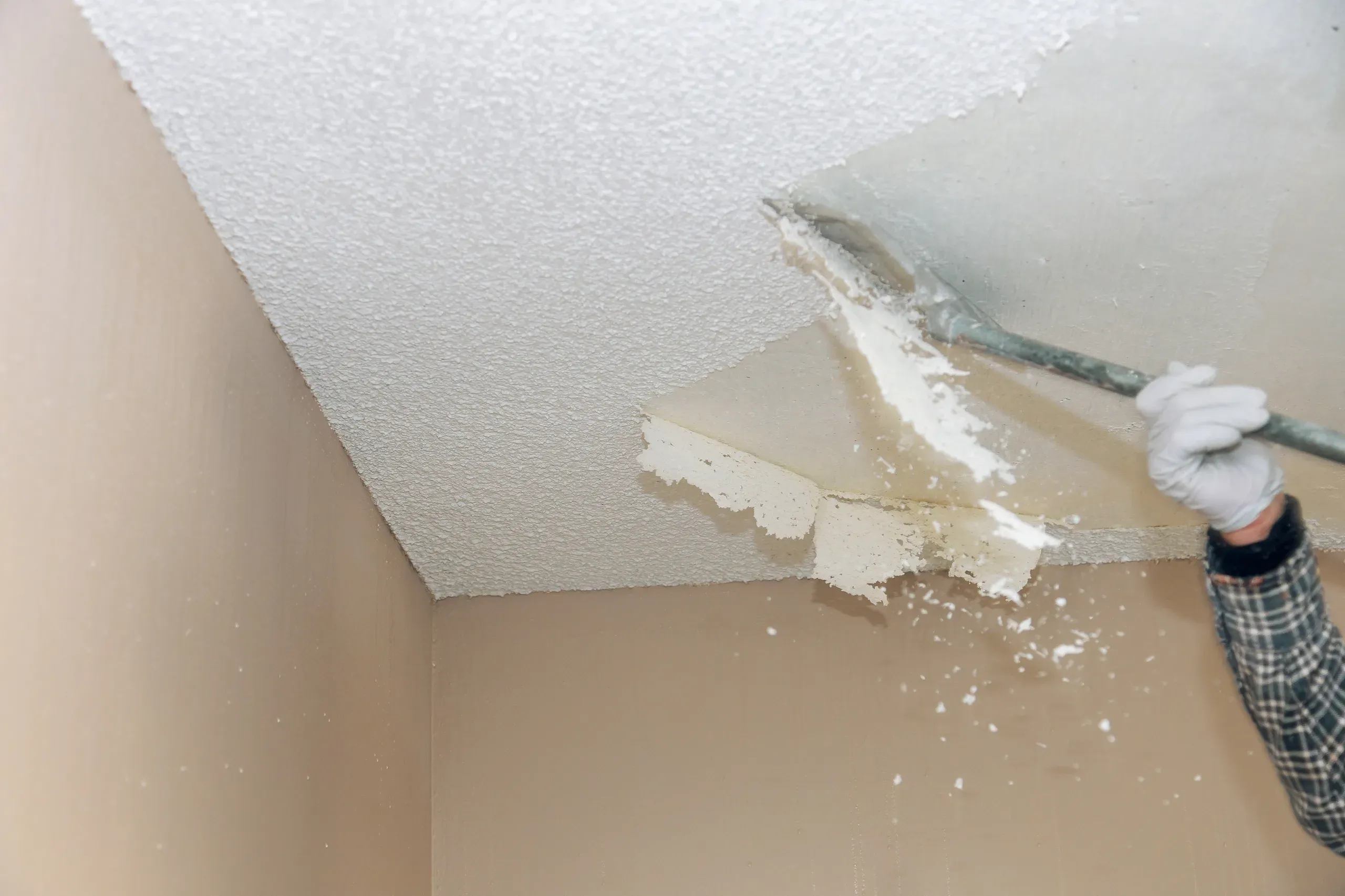
Popcorn ceiling removal strips the old spray-applied texture down to a smooth, paintable surface. Because a large share of Lynn’s housing predates 1978, the first and non-negotiable step is testing the texture for asbestos before any scraping, sanding, or wetting begins. Once a ceiling is cleared or handled under proper containment, Lynn Drywall & Plaster scrapes the texture, repairs any damage the original spray application concealed, and finishes the ceiling to a smooth or lightly re-textured surface to match the rest of the home.
This service is for owners of West Lynn and East Lynn triple-deckers and two-families built well before 1978, where popcorn or acoustic spray texture is original to the unit, and for landlords and property managers preparing a unit for turnover who want a modern, easy-to-clean ceiling that won’t flag on a rental inspection. It’s also for homebuyers or sellers dealing with an appraisal or inspection contingency tied to a dated or damaged textured ceiling, and for anyone renovating a kitchen or living room who wants the ceiling to match a newly smoothed or painted wall plane.
Why testing comes before anything else
Popcorn and acoustic spray ceiling textures were commonly applied with asbestos fibers as a binding and fire-resistance additive up until the material was restricted in the early 1980s. Because so much of West Lynn and East Lynn’s triple-decker and two-family housing stock dates to the shoe-manufacturing era or the decades right after, every original textured ceiling is treated as untested until proven otherwise. A small sample goes to a lab before any scraping, wetting, or sanding touches the surface. This isn’t a formality; dry-disturbing an asbestos-containing texture is how fibers become airborne, and that’s a health exposure for anyone in the home, not just a code violation.
What happens on either side of the test
A negative result clears the way for standard removal: light wetting to keep dust down, scraping the texture off, and finishing the bare ceiling. A positive result changes the sequence entirely. Work stops, and a MA Dept. of Labor Standards licensed abatement contractor handles the actual removal under proper containment and air monitoring. Once that space is cleared and documented, Lynn Drywall & Plaster comes back to patch, finish, and paint the ceiling. Homeowners sometimes assume this adds unnecessary delay, but skipping the abatement step to save time is exactly the shortcut that causes real harm.
What’s usually hiding under the texture
Original spray texture was often applied specifically to hide an uneven ceiling, whether that was a rough drywall finish, an old plaster surface with hairline cracking, or a seam that was never taped cleanly. Once the texture comes off, those imperfections are visible for the first time in decades. They get inspected and patched before any finish coat, because skimming or texturing over unrepaired damage just recreates the same problem the original popcorn was covering up.
Smooth versus re-texture
Not every homeowner wants a fully flat, Level 5 ceiling once the popcorn is gone. Some prefer a lighter knockdown or orange-peel texture that still hides minor ceiling imperfections without the outdated bumpy look. The finish goes to whichever target the homeowner wants, but a full smooth finish takes more coats and sanding than a re-texture, since the ceiling has to hold up to closer visual scrutiny with nothing left to camouflage it.
Turnover work and resale considerations
Landlords and property managers preparing a unit for the next tenant, and homeowners heading into a sale, both have a practical reason to remove dated popcorn texture: it reads as an immediate red flag to buyers and renters used to modern finishes, and it can surface as a line item in a home inspection. Documenting a clean asbestos test alongside the removal gives sellers something concrete to show if the question comes up during a sale.
Materials & standards
Products & materials we use
- USG Sheetrock
Standards & codes we work to
- EPA RRP (pre-1978 lead-safe)
- MA Dept. of Labor Standards (asbestos)
What the terms mean
- popcorn ceiling
- acoustic spray texture
- asbestos testing
- containment
- knockdown texture
- joint compound
Options & variants
| Option | When it applies | Cost |
|---|---|---|
| Test and clear, then scrape and smooth | Texture tests negative for asbestos | Standard scope, straightforward removal |
| Asbestos-containing texture, licensed abatement referral | Texture tests positive | Coordinated with a MA Dept. of Labor Standards licensed abatement contractor before finish work begins |
| Scrape and re-texture (knockdown or orange peel) instead of full smooth | Homeowner wants an updated but not fully flat ceiling | Similar labor to full smooth, different finish coat |
What affects cost
- • Whether the texture tests positive or negative for asbestos, since a positive result requires licensed abatement before any finish work.
- • Ceiling square footage and how thick or heavily applied the original texture is.
- • Condition of the drywall or plaster underneath once the texture is removed, since some ceilings need patching after scraping.
- • Whether the finish target is smooth, more labor, or a re-texture like knockdown.
- • Furniture and room prep required, since scraping is a messy, full-room process.
What to expect
- 1
Test the texture
A sample of the ceiling texture is tested for asbestos before anything is touched, since Lynn's housing stock is old enough that this can't be assumed either way.
- 2
Contain and scrape (if clear)
If it tests clear, the room is contained, the texture is lightly wetted to control dust, and it's scraped off.
- 3
Coordinate abatement (if positive)
If it tests positive, work pauses and a licensed abatement contractor removes it safely before the crew returns.
- 4
Patch the bare ceiling
Once bare, any damage or unevenness left behind gets patched, since original texture often hid minor imperfections.
- 5
Finish to target
The ceiling is finished to the target surface, either a smooth Level 4/5 ceiling or a modern re-texture like knockdown.
- 6
Prime and clean
The ceiling is primed and left ready for paint, and the room is cleaned of dust and debris before the crew leaves.
When this isn’t the right call
- If the ceiling texture tests positive for asbestos and needs full abatement before any drywall work, that phase is handled by a licensed abatement contractor, with Lynn Drywall & Plaster returning for the finish work after clearance.
- If the real goal is just blending a small patch into an existing texture, not removing the whole ceiling, texture matching is the better fit.
Frequently asked questions
How do I know if my ceiling has asbestos? +
You can't tell by looking. If your home was built before the early 1980s, which covers most of West Lynn and East Lynn's older triple-deckers, the texture gets tested before any scraping begins.
What happens if the test comes back positive? +
Work stops and a MA Dept. of Labor Standards licensed abatement contractor removes it safely. Lynn Drywall & Plaster returns to finish the ceiling once the space is cleared.
Can I scrape it myself to save money? +
That's strongly discouraged until it's tested. Dry-scraping an untested textured ceiling risks releasing fibers into the air if it does contain asbestos.
Will removing the popcorn texture damage the ceiling underneath? +
Sometimes the drywall or plaster underneath has minor imperfections the texture was hiding. Those get patched as part of the job before the final finish.
Do I have to go fully smooth, or can I choose a different texture? +
Either works. Some homeowners want a flat Level 5 ceiling, others prefer a lighter knockdown or orange-peel texture. The finish goes to whichever is chosen.
How messy is this process? +
Scraping generates a lot of debris and dust. The room is contained with plastic, but plan to clear furniture and keep the room closed off during the work.
Does this affect a home sale or appraisal? +
Popcorn ceilings sometimes get flagged in inspections or read as dated to buyers. Removing and documenting a negative asbestos test can help clear that concern.