
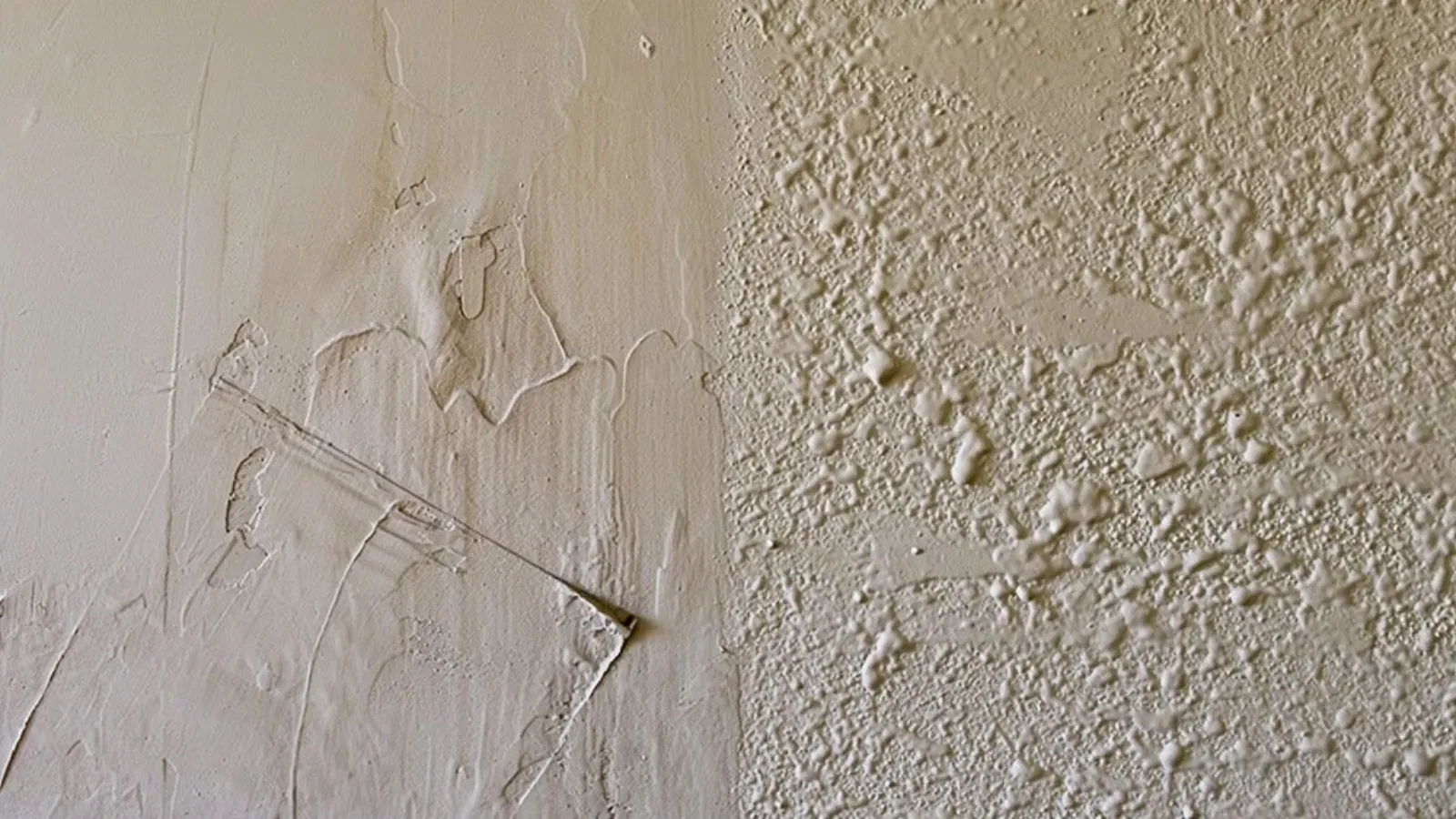
Signs you need this
- • A recently patched wall or ceiling section that's structurally fine but stands out as a smooth or differently-textured spot against the surrounding knockdown or orange-peel finish.
- • A prior repair, possibly by another contractor, that was never textured to match in a postwar ranch or cape toward Saugus or Peabody.
- • Uneven texture density where an old patch has been painted over multiple times, making the mismatch more visible with every repaint.
- • Natural light or a new light fixture makes a mismatched patch obvious in a way it wasn't before.
Texture matching applies the same spray or hand-applied texture pattern, most commonly knockdown or orange peel in Lynn’s postwar housing stock, to a patched or newly installed section of wall or ceiling so it blends into the surrounding surface. It’s a distinct skill from patching itself: getting the compound consistency, spray pattern, and knockdown timing close enough that the repaired area disappears rather than reading as a visibly different texture once painted.
This service is for homeowners in the postwar ranch, cape, and split-level ring toward Saugus, Peabody, and Lynnfield, where knockdown and orange-peel textures are the standard ceiling and wall finish, and for anyone with a prior drywall repair, whether from Lynn Drywall & Plaster or another contractor, that was patched but never texture-matched. It’s also for sellers preparing a home for listing photos who need visible patch marks blended before showings, and for homeowners updating a single room who want new drywall sections to disappear into the existing textured surface rather than reading as an obvious repair.
Why texture matching is its own skill, not an afterthought to patching
Patching a hole and texturing it to match are two different disciplines that happen to sit next to each other in the same job. A patch can be structurally perfect, taped and sanded flush with the surrounding wall, and still stand out immediately once painted if the texture doesn’t match. Knockdown and orange peel textures aren’t uniform by accident; they’re built from spray droplet size, compound consistency, timing before knockdown, and trowel pressure, all of which vary slightly by original installer and by how many decades of repainting have softened the pattern since. Getting a new section to read as part of the same wall means studying those variables on the specific wall in front of the crew, not applying a generic texture pass.
The postwar ring’s dominant finish
The ranches, capes, and split-levels that ring Lynn’s older core toward Saugus, Peabody, and Lynnfield were largely built and finished in an era when spray-applied knockdown texture was the standard interior wall and ceiling treatment, both for its aesthetic and because it’s forgiving of minor drywall imperfections underneath. That means texture matching work here is overwhelmingly knockdown-pattern work, with orange peel showing up more selectively on ceilings or in sections that were redone more recently. Knowing which pattern a given house was built with, rather than assuming, is the first step before any compound goes on the wall.
Matching through decades of paint
A texture pattern that was applied fresh in the 1960s or 70s doesn’t look the same today after ten or more coats of paint have settled into the low points and slightly rounded the high points. A brand-new texture pass, applied at full original sharpness, can actually look wrong next to a wall that’s been softened by decades of repainting. The patch gets compared against the current, aged state of the surrounding wall, not an idealized fresh version of the same texture, which sometimes means intentionally knocking the new texture down a bit further than a textbook application would call for.
Where texture matching shows up as a repeat problem
Texture mismatches left behind by a prior repair, sometimes one done by another contractor, are a common callback here. It’s a common shortcut: patch the hole, tape and sand it smooth, and skip the texture step entirely because it’s slower and requires spray equipment and masking that a quick patch job doesn’t always budget for. The result is a technically fixed hole that still reads as damage from across the room. Texture is treated as a required finishing step on every patch, and correcting a mismatch from earlier work is often a fast fix once the underlying patch is sound.
Feathering the edge, not just filling the center
The visible border between old and new texture is usually where a mismatch shows up first, not the center of the patch. The texture application feathers outward past the repaired area’s edge, blending gradually into the existing surface rather than stopping sharply at the patch boundary, which is what keeps the eye from finding a clean line where old wall meets new.
Materials & standards
Products & materials we use
- USG Sheetrock
Standards & codes we work to
- GA-214 finish levels
What the terms mean
- knockdown texture
- orange peel
- texture matching
- spray pattern
- feathering
- joint compound
Options & variants
| Option | When it applies | Cost |
|---|---|---|
| Knockdown texture match | Postwar ranch, cape, and split-level walls/ceilings with a stippled, flattened pattern | Standard scope for the most common local texture |
| Orange peel texture match | Lighter, finer stippled surface common on some ceilings and newer sections | Similar scope, different spray technique |
| Smooth-to-textured blend transition | Section was previously skim-coated smooth but needs to rejoin a textured wall | More labor to feather the transition zone |
What affects cost
- • Size of the area needing texture, since spray equipment setup makes a very small patch less efficient per square foot than a larger section.
- • How close the existing texture's pattern and density is to a standard match versus a custom or aged, hand-applied original.
- • Whether the surrounding wall has multiple paint layers that changed how the original texture reads today.
- • Ceiling versus wall work, since ceiling texture matching requires overhead spray control and containment.
- • Access and furniture protection needed for spray application.
What to expect
- 1
Examine the existing pattern
The existing texture pattern is examined closely, checking density, stipple size, and knockdown flatness against the patched or new area.
- 2
Mask and protect
Surrounding surfaces are masked off and flooring and furniture protected, since texture spray travels.
- 3
Mix and apply compound
Compound is mixed to the right consistency and applied to the target area using the matching method, spray or hand-applied.
- 4
Knock down to match
For knockdown, the texture sets briefly, then the peaks are knocked down with a trowel to match the surrounding flatness.
- 5
Compare and adjust
The dried result is compared against the surrounding wall under normal room light and adjusted if needed before calling it final.
- 6
Prime for paint
The area is primed so it's ready for paint that will read consistently across old and new texture.
When this isn’t the right call
- If the wall or ceiling hasn't been patched or repaired yet, drywall repair and patching is the better fit first, then texture matching after.
- If the goal is actually removing texture entirely for a smooth finish, not matching it, popcorn ceiling removal or skim coat / Level 5 finish is the better fit.
Frequently asked questions
Why does my patch still look obvious even though the hole is fixed? +
A structurally sound patch that's left smooth while the surrounding wall is textured will always stand out once painted. Texture matching is the step that makes the repair disappear visually, not just structurally.
Can you match texture from a repair another contractor did? +
Yes, the existing pattern gets assessed and a new texture pass blended over the smooth or mismatched area regardless of who did the original patch.
What texture is most common in my neighborhood? +
Knockdown is the dominant texture in the postwar ranches, capes, and split-levels toward Saugus and Peabody. Orange peel shows up on some ceilings and newer sections.
Will the texture match perfectly, or will I still see a line? +
A well-executed match should be very difficult to spot under normal room lighting. It gets checked before finishing and adjusted for density or pattern if it's not close enough.
Do you need to redo the whole wall, or just the patched section? +
Usually just the patched section and a small feathered border around it, not the entire wall, unless the surrounding texture is inconsistent to begin with.
Can you texture match a ceiling as well as walls? +
Yes, ceiling texture matching uses the same techniques with additional overhead containment to control overspray.